
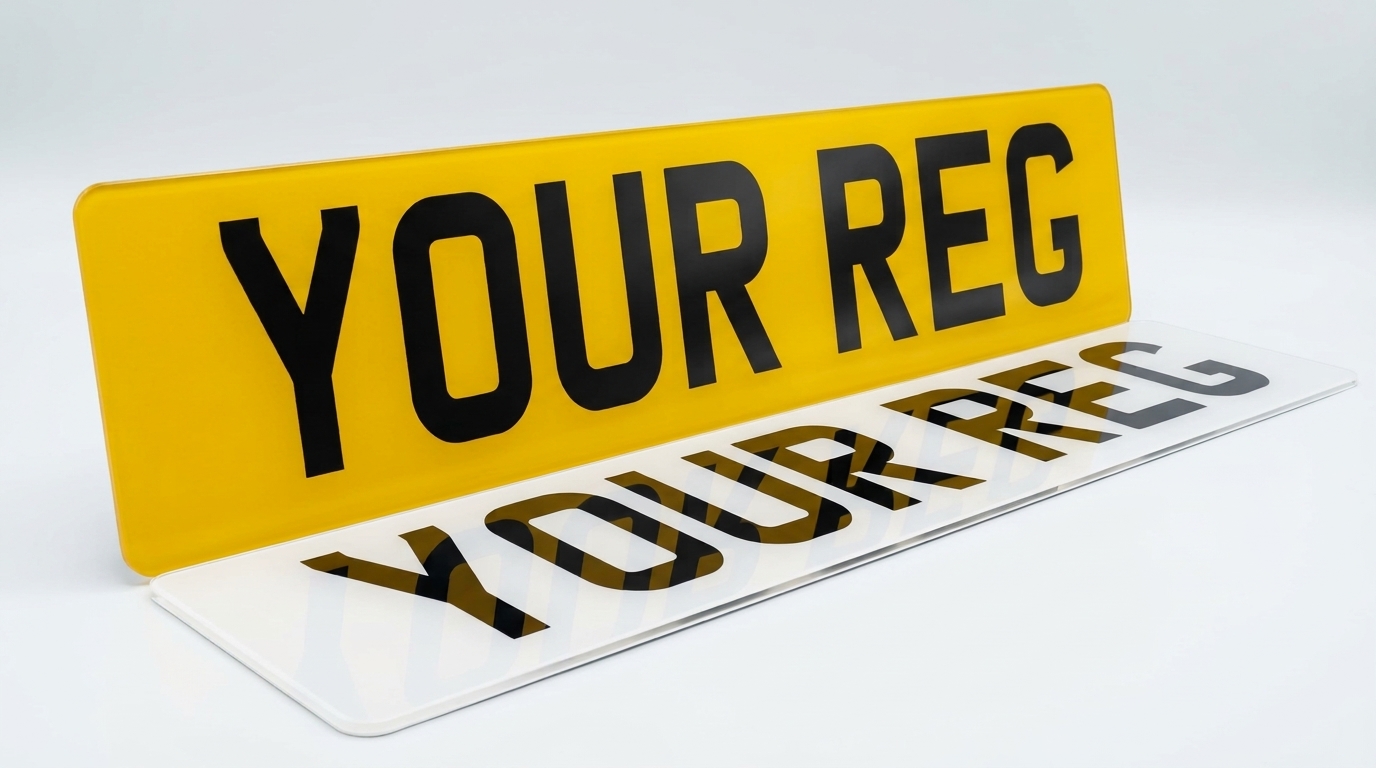
White at the front, yellow at the back: why UK plates differ
In this guide
UK plates are white at the front and yellow at the rear because the display rules set a different background colour for each end of the vehicle, with black characters on both. It is not a styling choice: a yellow front plate or a white rear plate does not meet the specification. The rule applies to vehicles manufactured after 1 January 1973.
What the rules require
GOV.UK sets out the required features in a short list. A plate has to be made from a reflective material, display black characters on a white background at the front of the vehicle, display black characters on a yellow background at the rear, and carry no background pattern.
It also has to be marked to show who supplied it, and to show a British Standard number, which is BS AU 145e for plates fitted after 1 September 2021. The characters must not be removable or reflective, and on plates fitted after that date they must be a single shade of black.
Neither GOV.UK nor INF104 gives a reason for the two colours. They simply set the background for each position: white at the front of the vehicle and yellow at the back, with black characters on both.
The colour is only one part of the specification
A plate that gets the background colours right but the characters wrong is still not compliant. The character measurements are fixed: 79mm tall and 50mm wide, apart from the number 1 and the letter I, with a 14mm stroke. There is 11mm between characters, 33mm between the age identifier and the random letters, and an 11mm margin around the plate.
The font matters too. A standard font was introduced on 1 September 2001, which ended the use of italics and other letter shapes that are harder to read. A plate fitted from that date has to use it, whatever colour the background is.
The single-plate problem
Most cars need both colours because they need both plates. It matters when only one plate is damaged. If the front plate is cracked, the replacement is white; if the rear is faded, the replacement is yellow. A plate in the wrong colour for its position does not meet the rules.
We list the front and rear separately so the colour is fixed at the point of order: a white front plate on its own and a yellow rear plate on its own in the 2D finish. A full pair is the simpler order when both need replacing, and our page on damaged plate replacements covers single plates and pairs.
Where black plates fit in
Vehicles manufactured before 1 January 1973 may display traditional black and white plates, for example white, silver or grey characters on a black plate. From April 2020, vehicles manufactured before 1 January 1980 can also display them, provided the keeper has applied to DVLA and the vehicle is registered in the historic vehicles tax class.
Those are exceptions with conditions attached, not a general option. A car that does not meet them needs the white and yellow pair like any other.
Motorcycles are a different case
Motorcycles and motor tricycles registered on or after 1 September 2001 must display a number plate at the rear only. The characters sit on two lines, and the measurements are smaller: 64mm tall and 44mm wide, with a 10mm stroke, 10mm between characters and at least an 11mm margin. A bike still shows a rear plate in yellow.
What goes wrong with plate colour
- •A tinted or smoked cover changes the background colour, so the plate no longer shows the required white or yellow.
- •A background pattern is not allowed on the plate.
- •A faded plate is one of the reasons our replacement page lists for ordering a new one.
- •A plate in the wrong colour for its position does not meet the rules, however good the characters look.
The penalty is set out plainly. GOV.UK says you could be fined up to £1,000 and your vehicle will fail its MOT test if you drive with incorrectly displayed number plates. Our guide to why plates fail the MOT covers the rest of the display checks.
Key points
- •A UK plate is white at the front and yellow at the rear, with black characters on both.
- •The rule is part of the design specification for vehicles made after 1 January 1973.
- •It is not a style choice: a plate in the wrong colour for its end of the car does not meet the rules.
- •The plates must also show who supplied them, and BS AU 145e if fitted after 1 September 2021.
- •Black and white plates are limited to vehicles made before 1 January 1973, and to vehicles made before 1 January 1980 that meet the historic vehicle conditions.
- •Incorrect plates can mean a fine of up to £1,000 and an MOT failure.
Questions people ask
Can I have a yellow plate on the front?
No. The front plate has to show black characters on a white background. Yellow belongs at the rear, and swapping them puts both plates outside the specification.
Why are the characters black on both plates?
Because the rules require black letters and numbers on both backgrounds, and a single shade of black on plates fitted after 1 September 2021. The colour of the background changes; the colour of the characters does not.
Can I fit a black plate to a classic car?
Only if the vehicle qualifies. Traditional black and white plates are allowed on vehicles manufactured before 1 January 1973, and from April 2020 on vehicles manufactured before 1 January 1980 that have applied to DVLA and are in the historic vehicles tax class.
Does a cover change the colour of my plate?
A tinted or smoked cover does. It alters how the background reads, which is why a covered plate stops meeting the colour requirement. Keep the plate face clear.
Do I need two new plates if one is damaged?
No. A single plate in the correct colour for its position is fine: our 2D front-only and rear-only plates are £15 each. If both are faded or worn, the 2D pair is £25.
Every pair and single in the number plate collection is made in the right colour for its position, so the choice of finish does not change what the plate has to show.
Sources
GOV.UK: Displaying number platesThe required background colours, the markings and the penalty for incorrect plates.https://www.gov.uk/displaying-number-platesDVLA leaflet INF104: vehicle registration numbers and number platesThe design specification, the traditional plate conditions and the character measurements.https://www.gov.uk/government/publications/vehicle-registration-numbers-and-number-platesKeep reading
Ready to Customise Your Plate ""?
Try 3D Gel, 4D 3mm Laser, and 4D 6mm Standout styles in our live interactive studio.