
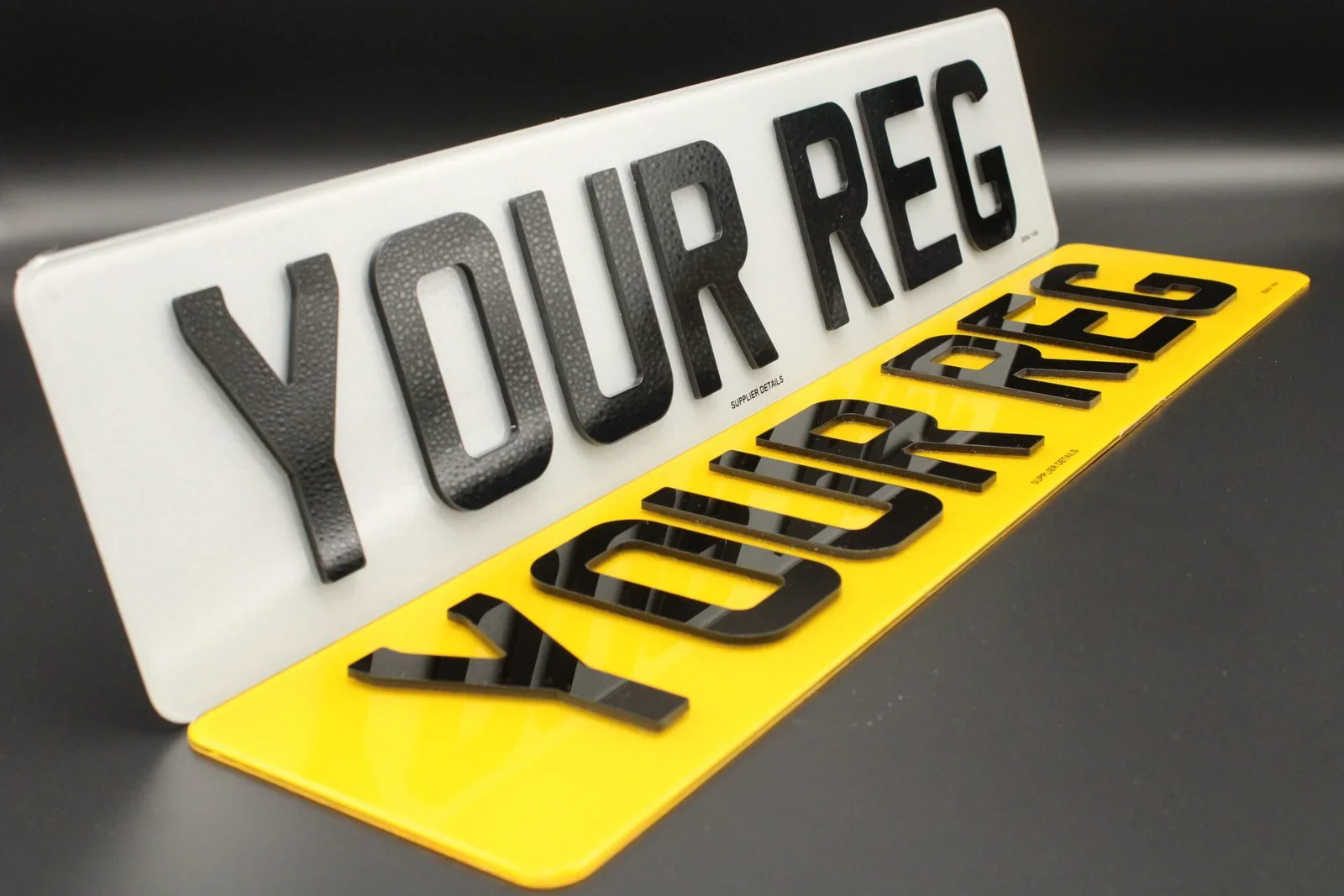
Do 3D and 4D plates confuse ANPR and speed cameras?
In this guide
The rules that apply to a 4D plate are the same rules that apply to any plate. They fix the font, size, spacing and colour so the registration reads the same way on every vehicle. A plate built to those rules is built to be read. We cannot promise that any individual camera will read any individual plate, and we do not claim that a raised finish defeats or improves a camera.
The short answer
There is no DVLA rule that treats a 3D or 4D plate differently to a flat one. The regulations set one standard for every road-legal plate: the same font, the same character size, the same spacing, the same colours and the same markings. If those are right, the plate shows the registration the way the rules require.
Why the standard font exists
The standard font was introduced on 1 September 2001 to make number plates easier to read. It ended the use of italics and styled lettering that could be misread. That is the same reason a plate has fixed character sizes and fixed gaps: a registration should look identical whether it is on a hatchback or a van.
What makes a plate readable
- •The registration in the standard font, not a styled or italic version.
- •Characters 79mm tall and 50mm wide, with a 14mm stroke.
- •11mm between characters, 33mm between the age identifier and the random letters, and 11mm margins.
- •Black characters on a clean white front plate or yellow rear plate.
- •No tint, cover or obstruction across the characters.
- •A plate that is clean enough to read.
Those are the legal requirements, and they are also the things that make a plate legible. A raised plate that meets them has the same letter shapes in the same positions as a flat plate.
Where raised plates can cause a problem
- •Reflective or chrome faces. Characters must not be reflective, so a mirror face fails the display rules before a camera is involved.
- •A tinted or smoked cover. It changes the background colour and lowers contrast.
- •A dirty plate. A film of road grime over the characters hides the registration.
- •An obstruction. A bike rack, tow bar or trailer can cover part of the plate.
- •A plate trimmed into the margin. The 11mm margin has to remain, even on a short plate.
None of those is caused by the depth of the characters. They are display faults, and they matter on a 2D plate just as much as on a 4D Premium finish or a raised 3D gel range.
The rules do not mention cameras
It is worth being precise about what the regulations do. They govern how plates are designed, manufactured and displayed. They do not promise a camera result, and they do not set a separate standard for raised characters. Anyone who tells you a 4D plate is camera-proof, or that it always fails a camera, is going beyond what the rules say.
The safest position is the legal one: keep the plate to the standard and keep it readable. Our standard behind the font guide covers the requirements in full.
If a camera misreads your plate
Start with the plate itself. Is it clean, complete and free of covers? Are the characters the standard font, with the right spacing and margins? Is the marking still legible? If the plate is damaged, replace it. If the plate is legal and clean, the fault is not something you can fix with a different finish.
A plate that stops reading is also a plate that can attract a fine, so the two issues often arrive together. Our article on when a plate becomes a fine explains where that line sits.
Key points
- •The display rules do not treat raised plates differently.
- •The standard font, size and spacing exist to make every plate easier to read.
- •Reflective faces, tints, dirt and obstructions are the real problems.
- •The rules do not promise a camera result in either direction.
- •Keep the plate clean and to the standard, and replace it when it is damaged.
Questions people ask
Do 4D plates fail ANPR?
There is no DVLA rule that singles out 4D plates. A 4D plate that keeps the standard font, spacing, colour and markings meets the same display rules as any other plate. We have no test data that would let us claim a camera result either way.
Does the gel dome affect a camera?
We do not make a claim about how a particular camera sees a gel dome. What we can say is that a clear dome over black characters keeps the characters black and the background white or yellow, which is what the display rules require.
Do tinted plates stop cameras?
The question does not really arise, because a tinted plate is not road legal. A tint changes the background colour and lowers contrast, so the plate fails the display rules before any camera question matters.
Does a private registration read differently?
No. A private registration uses the same characters in the same font and format as any other registration. The plate rules do not change because the number was bought rather than issued.
Can I fit a tinted plate cover?
No. A tinted cover changes the background colour and can stop the registration reading, so the plate no longer meets the display rules. Keep the plate face clear.
If you want a raised plate without any reflective or tinted add-ons, shop the number plate range and choose black characters on a standard reflective blank.
Sources
GOV.UK: Displaying number platesDVLA rules on the standard font, colours, characters and markings.https://www.gov.uk/displaying-number-platesDVLA leaflet INF104: vehicle registration numbers and number platesThe standard font and the exact character, spacing and margin measurements.https://www.gov.uk/government/publications/vehicle-registration-numbers-and-number-platesKeep reading
Ready to Customise Your Plate ""?
Try 3D Gel, 4D 3mm Laser, and 4D 6mm Standout styles in our live interactive studio.